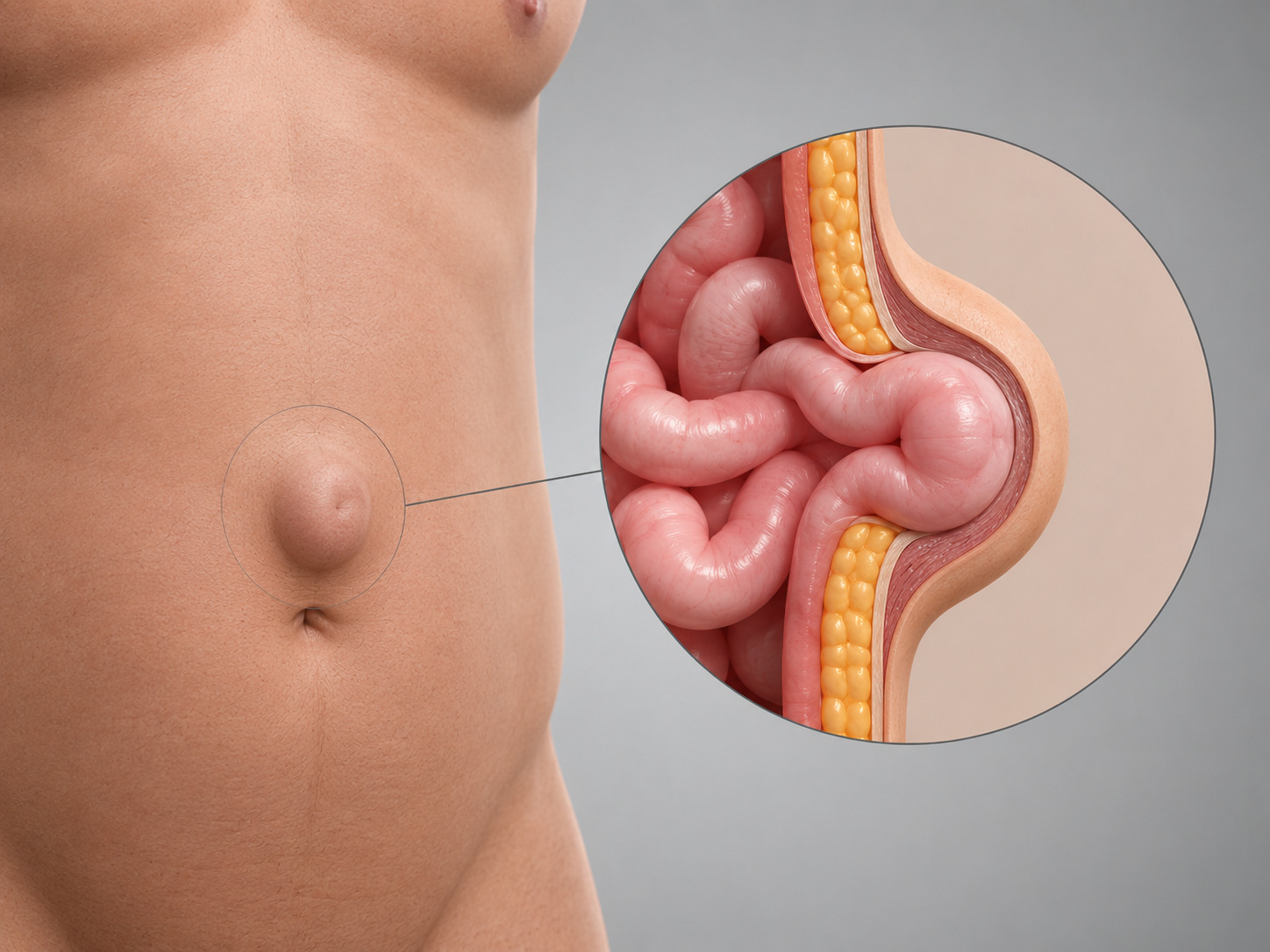
An umbilical hernia forms at or near the navel, where the abdominal wall is naturally weaker. Common after pregnancy or with weight gain, adult umbilical hernias do not close on their own — SurgiKure repairs them laparoscopically with mesh.
What is an Umbilical Hernia?
An umbilical hernia happens when abdominal tissue pushes through a weak point in the muscle around the belly button, creating a soft bulge. While many infant umbilical hernias close naturally, in adults they persist and gradually enlarge. They are especially common in women after pregnancy, in people who are overweight, and in anyone with chronic straining.
Symptoms to Watch For
- A soft bulge or swelling at or near the navel
- The bulge becomes more visible when standing, coughing or straining
- Aching or pulling discomfort around the belly button
- Tenderness that increases after activity
- The swelling slowly enlarging over months
Why Treatment Matters
Adult umbilical hernias never resolve without surgery and only grow larger, making later repair more complex. An enlarging hernia also carries a rising risk of tissue becoming trapped. Early, planned laparoscopic repair is simpler, safer and gives a durable result.
Umbilical Hernia Treatment at SurgiKure
SurgiKure repairs umbilical hernias laparoscopically, placing a mesh from the inside to reinforce the weak area around the navel. This keyhole approach means minimal pain, barely visible scars and same-day discharge for most patients. Larger or recurrent umbilical hernias are also treated with advanced mesh techniques.
- Keyhole (laparoscopic) surgery — tiny cuts, minimal pain
- Strong mesh repair — recurrence under 1%
- Same-day discharge for most patients
- Insurance cashless support handled for you
- Free follow-up care included
Ready to Consult a Hernia Specialist?
Free first consultation with Dr. Polisetti Ramachandra Rao. Same-day appointments available.